

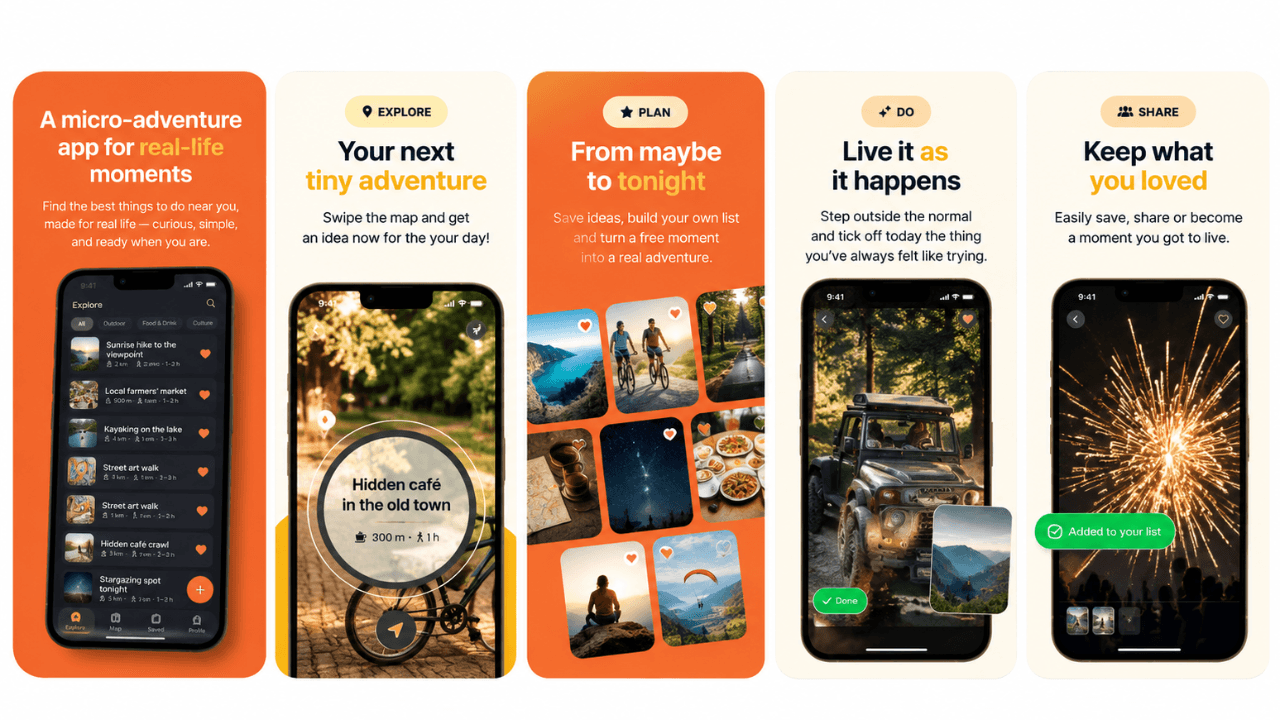
People often want to do more interesting things but struggle to decide what to do, find the energy to organise something, or commit to a big activity.
Consumer app Whimscope aims to remove that struggle by helping people break out of their everyday routines through small, achievable adventures based on their available time, energy, and mood.
Think of it as a combination of an activity discovery app, a bucket list, and a gentle nudge to do something different.
Whimscope follows a three-stage process: Dream, Plan, Do. Users discover activities and experiences, choose something to try immediately or save for later, and record their completed adventures through photos, notes, and memories.
These activities, known as whims, range from small everyday experiences to more ambitious adventures, such as trying a new hobby, visiting a local attraction, learning to surf, taking a spontaneous trip to a lighthouse, or planning a memorable day out with family. Some take just 15 minutes, while others might fill an evening or an entire weekend, and can be enjoyed alone or with others.
The app launched publicly on 7 August 2026, following closed testing with a small group of users. It is available on Apple's App Store and Google Play as Whimscope: Fun Things to Do, with regular updates continuing after launch.
Vladislav Kuksenko, an entrepreneur from Odesa, is behind the app and is currently serving in the Armed Forces of Ukraine.
From a late-night idea to an action app
The idea for Whimscope emerged in 2020, when COVID-19 restrictions left people confined to their homes and looking for ways to fill their free time. Kuksenko recalls:
“Everyone was staying at home because of COVID, a lot of places were closed, and there wasn't much to do in people's free time. People were asking themselves, ‘What can I do right now? I'm bored at home.’”
On 2 September 2020, unable to sleep, he began thinking about an app that could help people discover activities and experiences.
“The idea just came into my head: maybe it would be a good idea to create an application that could help people find activities, events, or ‘whims’, as we call them. I got out of bed, went to my computer, and drew that sketch in Paint. It was really simple. From that point, I started working on the project.”
Kuksenko had previously founded Mad Lion Studios, a ten-person game development company specialising in creating 3D models for games. However, he had no experience developing mobile applications.
Whimscope's first iteration was developed without AI. A friend helped create the initial wireframes, and Kuksenko subsequently recruited a React Native developer to begin building the app.
“When we started working on it, I didn't have any experience creating mobile applications.
I started learning about the process, the pipeline, and the steps we needed to go through to create the project. It took us about two years to create a working prototype.”
By 2022, the team had a functioning prototype, but Russia's full-scale invasion of Ukraine prevented its release.
The project would not reach the public until August 2026.
Building a startup alongside military service
Bringing Whimscope to market has meant balancing startup development with military responsibilities, which Kuksenko estimates consume around 90 per cent of his time.
During our interview, as he discussed the importance of making time for meaningful experiences, an air-raid alert interrupted the conversation. We subsequently completed the interview in writing.
For Kuksenko, team calls sometimes happen during lunch breaks, from his car or nearby, while he handles product questions and updates in the evenings. He admits:
“It is exhausting. There is no point pretending otherwise. But Whimscope is also something that is mine. It is a personal goal and something I am building beyond my military role.”
Maintaining a personal project alongside military service carries significance beyond entrepreneurship, as he explained:
“I think many people who are serving now will understand that feeling: it matters to have something you are creating for yourself as well, not only things you are required to do for others.”
Whimscope secured an undisclosed amount of investment, which funded development and launch of the app's first version, with a development team building the initial product. Since then, Kuksenko has begun handling smaller technical changes himself, despite coming from a project management rather than software development background.
AI coding tools have helped him understand the codebase, test ideas, and make updates without needing a development team for every change.
“Even a couple of years ago, I would not have imagined being able to make meaningful changes to a live product myself without being a developer.”
He acknowledges that more complex work still requires experienced developers, but being able to implement smaller changes independently has helped keep Whimscope moving forward despite his limited availability.
Turning saved ideas into real experiences
A growing number of apps are attempting to move people away from passive scrolling and towards real-world experiences. Platforms such as Timeleft and Tasteit focus on bringing strangers together through shared activities and social experiences.
However, Kuksenko argues that Whimscope addresses a different problem: helping people turn things they have always wanted to do into experiences, whether alone or with others.
“Life is bigger than social gatherings. Someone wants to learn to surf. Someone else wants to drive to a lighthouse they saw years ago. A parent may simply want to make sure they do something memorable with their child once a month.”
For Kuksenko, limiting the platform to meeting new people would exclude a significant part of what users want to experience.
“For us, the question isn't really who are you doing it with? It is: are the things you want to do actually making it into your life? Sometimes that involves other people. Sometimes it doesn't.”
Finding users before revenue
Whimscope remains in the early stages, with about 550 users. Rather than pursuing rapid growth through mass marketing, Kuksenko is concentrating on understanding which audiences are most interested in the product.
“We are still very early, with around 550 users, so right now I care more about learning where the right users come from than about chasing a large number.”
One of the company's main acquisition strategies is working with content creators who already share travel recommendations, family activities, local destinations, and other experiences. The team approaches creators individually, including those with relatively small audiences.
“We contact them personally, including very small creators. In many cases, they have a much stronger relationship with their audience than a large account does.”
Whimscope is also developing a creator programme called First Light. The first ten creators to reach 1,000 followers within the app will receive a profile badge, a bonus, and recognition in a dedicated section.
“For now, growth is very hands-on. But at this stage, I think that is useful: every conversation teaches us something about who the product is really for.”
For now, the core product will remain free, although Kuksenko is considering two potential revenue streams. The first is a premium subscription offering additional features, including unlimited idea generation, shared lists, AI-generated to-do lists, and tools that transform photos and videos from completed experiences into short memory videos. The second is partnerships with local businesses, venues, and event organisers.
However, Kuksenko is cautious about allowing commercial relationships to determine which experiences users see.
“I don't want Whimscope to become another advertising feed. If we recommend a particular place or event, it should be there because it genuinely fits what someone wants to do, not simply because somebody paid to be shown.”
He stresses that monetisation is not an immediate priority. The first challenge is showing that people want to use Whimscope and will keep returning.
Kuksenko describes the August launch as the start of that process rather than the product's completion.
“I would describe it as a live launch rather than a finished release. The product is out there, and people can use it, but we are still learning what it should ultimately become.”
Making time for the moments that matter
Whimscope reflects Kuksenko's broader philosophy about how people spend their time and what makes life meaningful. He points to a favourite saying: Life is measured not by the number of days we live, but by the moments that take our breath away.
“I think we are very good at measuring the other parts of life: work completed, goals reached, tasks closed, days filled. The things we actually want to remember are much harder to see.”
For Kuksenko, the aim is not to help users become more productive, but to encourage them to reflect on whether the things they have always wanted to do have actually become part of their lives. Living in Ukraine has made that ambition particularly personal.
“Planning far ahead can feel abstract here. Writing down something you still want to see, learn, or experience is a very small thing. But sometimes even that feels like a way of saying: I still expect there to be a future.”
Whimscope is available to download for free on iOS and Android.


Would you like to write the first comment?
Login to post comments