

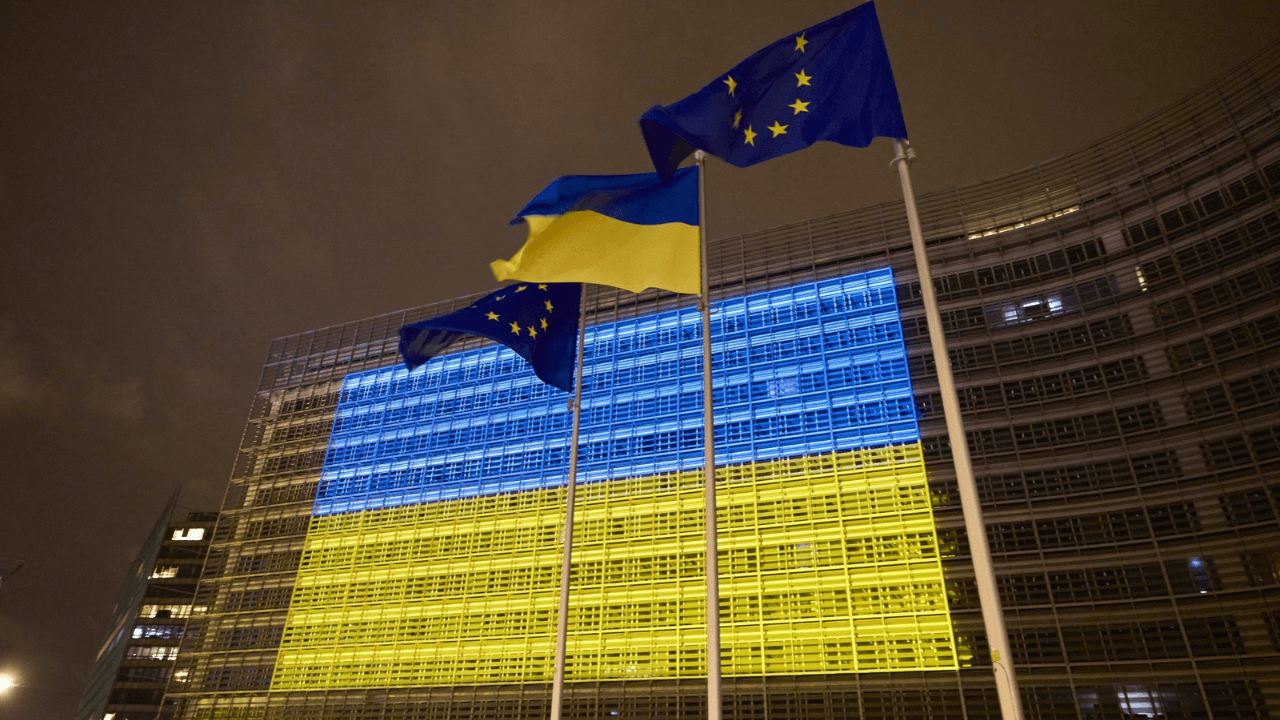
More than 85 senior European figures, including four former Presidents of the European Parliament, two former heads of state and two former prime ministers, have joined members of the European Young Leaders (EYL40) network in calling on EU governments to make a decisive, long-term financial and political commitment to Ukraine at this week’s European Council summit on 26–27 November.
In a manifesto published ahead of the summit, the signatories are urging governments to deliver what they describe as a Mario Draghi-style “whatever it takes” moment for Ukraine.
“We call upon our leaders to confirm the current ambitions towards Ukraine, to speed up delivery, to start using the Russian assets as a lever and to more clearly explain the importance of those decisions to our citizens.”
The initiative, spearheaded by the European Young Leaders network and the Ukraine Initiative of Brussels-based think tank Friends of Europe, is supported by entrepreneurs, former political leaders and public figures across the continent.
The signatories argue that Europe must send an unequivocal message to Moscow: Ukraine will not run out of the resources it needs to defend itself, and Europe will not lose the political will to support it.
Three demands for EU leaders
The manifesto calls on EU leaders to take three concrete decisions at the summit:
1. Close Ukraine’s €70 billion funding gap for 2027
EU governments should agree on the financing needed to sustain Ukraine through next year, building on the European Commission’s proposals. Funds should be released early enough to support essential public services, repair damaged energy infrastructure and maintain air defences through the winter.
2. Guarantee long-term support in the EU’s 2028–2034 budget
Financial and military assistance should be embedded in the EU’s next multiannual budget, providing Ukraine with the certainty needed to plan its defence and reconstruction.
The signatories also call for a fairer distribution of financial responsibility among European countries, rather than placing a disproportionate burden on Northern and Baltic states. They propose that a coalition of willing governments should be able to sustain support without allowing a single member state to block progress.
3. Mobilise €210 billion in frozen Russian assets
The European Commission should advance proposals to use frozen Russian assets to support Ukraine, with the associated legal and financial risks shared collectively among EU member states.
The signatories argue that Russia should bear the financial consequences of its invasion, rather than leaving European taxpayers and Ukraine to shoulder the burden alone.
“Helping Ukraine is not charity. It is self-defence — and Europe is sitting on €210 billion of frozen Russian money that should also be paying for it today.”
A ‘whatever it takes’ moment for Ukraine
The manifesto draws a parallel with the eurozone crisis of 2012, when then-European Central Bank President Mario Draghi pledged to do “whatever it takes” to preserve the euro, helping restore market confidence without immediately deploying new funds.
The signatories argue that Russia is now making a similar calculation about Europe’s resolve, betting that political divisions, budget disputes and public fatigue will ultimately weaken Western support for Ukraine.
The cost of hesitation could be far greater than the cost of sustained support.
Europe’s current support for Ukraine amounts to approximately 0.25 per cent of its GDP. Rather than demanding a dramatic increase in spending, the signatories want governments to make existing commitments more predictable, equitable and durable.
They argue that sustained assistance would not only strengthen Ukraine’s ability to defend itself but also support European jobs, defence manufacturing and technological innovation, while reducing the risk of a wider and considerably more costly conflict.
‘Stop calling it foreign aid’: Europe’s own security is at stake
Central to the manifesto is the argument that supporting Ukraine is an act of European self-defence rather than foreign aid. The signatories point to Russian-linked sabotage, drone incursions, cyberattacks and other security threats already affecting European countries. The manifesto states:
“Stop calling it foreign aid. Russia’s war is no longer something happening on a map a thousand kilometres away — it is already inside our airports, our power grids, and the delivery vans outside our front doors.”
The manifesto cites disruptions at European airports, suspected sabotage involving logistics infrastructure, cyberattacks on energy and water systems, and threats to undersea communications cables.
German police logged 165 suspected sabotage cases and 747 suspicious drone sightings in just eight months, while more than 150 Russian sabotage and cyber operations have struck European soil since 2022.
“Moscow is testing how much fear and disruption ordinary Europeans will swallow before we look away — while whispering that helping Ukraine costs too much.
Calling support for Ukraine ‘charity’ is the biggest lie in Europe today. You do not give charity to the firefighter standing between a spreading blaze and your own home.
Every air defence interceptor built in a European factory for Ukraine is the exact same technology needed over Brussels, Leipzig, and Copenhagen — keeping missiles off Ukrainian apartment blocks tonight and off our own cities tomorrow.”
‘The time for legal footnotes is over’
Karoli Hindriks, European Young Leader and Estonian founder and CEO of Jobbatical, argues that Europe must overcome its hesitation over mobilising frozen Russian assets.
“We are treating Ukraine’s survival like a charity case while Europe literally guards €210 billion of the arsonist’s cash. “I grew up in the shadow of Soviet occupation, and I know what happens when you wait for terror to stop itself. Europe is already under attack.
This is self-defence, not foreign aid. The time for legal footnotes is over.”
Geert Cami, Co-Founder and Vice President of the Governing Board of Friends of Europe, said the summit offered European governments an opportunity to demonstrate that their support for Ukraine would not falter.
“Whatever leaders decide on Thursday, it must be backed by a clear and unambiguous narrative: Europe will do whatever it takes.
And we owe our citizens an honest explanation: supporting Ukraine does not prolong the atrocities and human suffering of this war; it is the precondition for a sustainable peace. That is the message that will convince Moscow it cannot outwait us.”
A message to Moscow — and Europe’s citizens
Beyond the immediate funding decisions, the manifesto calls for a stronger and more consistent public explanation of why European support for Ukraine is essential to the continent’s own security.
The signatories also call on international partners, including the United Kingdom, Norway, Canada, the United States, Switzerland and Japan, to help underpin a sustained, coordinated commitment. Ultimately, the manifesto urges EU leaders to leave the summit with a single, unmistakable declaration:
“Europe will ensure that Ukraine has the means to defend itself and secure a just and lasting peace. We will provide predictable, long-term financial and military support and act together to ensure that Moscow understands that it cannot achieve its war objectives.”
Just as Draghi’s intervention in 2012 demonstrated Europe’s determination to defend the euro, the signatories argue that a similarly decisive commitment today could change Moscow’s calculations about the war. Europe must demonstrate that Russia cannot win simply by waiting for European resolve to collapse.
Bringing together Europe’s political, entrepreneurial and civil society leaders
Signatories include :
- former Presidents of the European Parliament Josep Borrell, Pat Cox, Hans-Gert Pöttering and Enrique Barón Crespo;
- former President of Estonia Toomas Hendrik Ilves;
- former President of Lithuania Dalia Grybauskaitė;
- former Italian Prime Minister Enrico Letta;
- former Belgian Prime Minister Guy Verhofstadt; and
- former EU Trade Commissioners Pascal Lamy and Cecilia Malmström.
Other notable signatories from the technology and startup ecosystem include:
- Karen Burns, co-founder and CEO of Fyma;
- Daumantas Dvilinskas, co-founder and CEO of TransferGo;
- Lubomila Jordanova, co-founder of Greentech Alliance;
- Marta Krupinska, co-founder and CEO of CUR8;
- Kristjan Maruste, co-founder and CEO of Kõu Mobility Group;
- Andres Osula, founder of Turnit;
- Pawel Radziszewski, co-founder and CEO of PEAR Power and former CTO of Nevomo;
- Lukasz Dzienkonski, CEO and managing partner of Montis Capital Fund;
- Nina Rawal, founder of Emerging Health Ventures;
- and André Loesekrug-Pietri, chairman and scientific director of the Joint European Disruptive Initiative (JEDI).


Would you like to write the first comment?
Login to post comments