

AI-driven sports media and sports tech’s Sportway Media Group has raised €20 million, valuing the company at approximately €92 million ( SEK 1 billion) post-money. The financing was led by Gamma Waves alongside continued participation from existing shareholders.
Founded in 2017 by serial entrepreneurs Jonas Persson and Daniel Franck, Sportway’s platform and managed service enable sports federations, leagues, clubs and media companies to professionally produce, distribute and monetise live sports content at scale.
I spoke to Daniel Franck to learn all about it.
From the sidelines to a global sports media platform
According to Franck, the idea for the company came from a very simple personal experience:
“When our children started playing sports, we realised that if we couldn't attend a match ourselves — because we were travelling or otherwise occupied — we were incredibly curious about how the game was going.
What was the score? Who scored? How was our child playing?
At the same time, the parents who were at the games often found themselves standing on the sidelines filming rather than actually watching and enjoying the match.”
Coming from a background in sports broadcasting and production, the team saw an opportunity to combine its professional expertise with a real need within grassroots sports.
“We believed technology could make it possible to produce and distribute this type of content cost-effectively while respecting the level and context of the sport,” shared Franck.
What has emerged is a highly community-driven business that supports federations, clubs, teams, players and families by making local sport accessible.
Beyond the entertainment value, the video and data generated through Sportway's platform support coaching, referee education, player development and player safety initiatives.
By combining AI and automation, the company enables athletes, coaches, families and fans at every level of sport to access professional-quality coverage that was previously available only to elite competitions.
Building a global sports media infrastructure
Today, Sportway operates in more than 20 countries, working with over 70 sports federations and leagues. The company has deployed approximately 2,500 AI-powered camera systems across 21 countries, producing more than 250,000 live sporting events each year.
Among Sportway’s long-term partners are the Swedish Ice Hockey Association and the Finnish Ice Hockey Association, where the company powers two of Europe’s most successful federation-owned streaming platforms. Recent client acquisitions include the Royal Dutch Hockey Association (KNHB) and the Norwegian Tennis and Padel Federation, further strengthening Sportway’s position as a trusted technology and media partner for leading sports organisations worldwide.
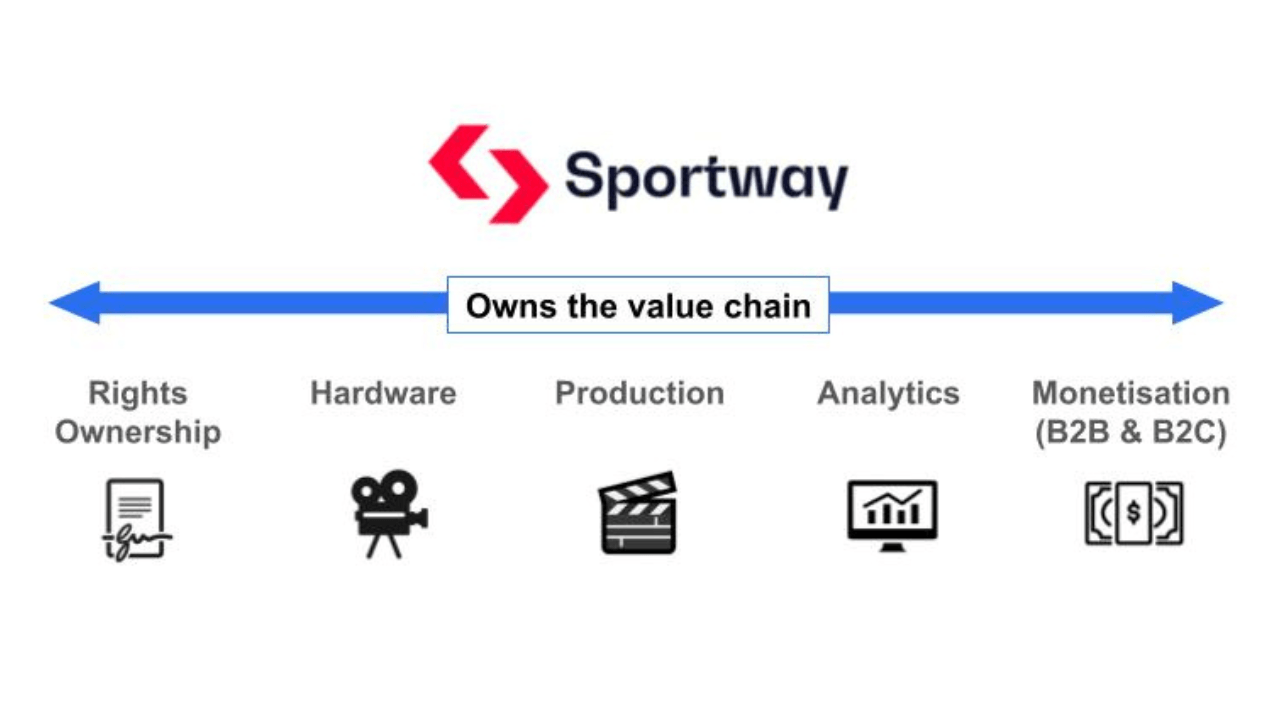
Sportway has built a fully integrated technology ecosystem spanning automated production, OTT distribution, analytics, and AI-powered content creation.
Why scale is the real challenge
Advances in AI, automation and data analytics are fundamentally reshaping how sports content is produced, distributed and monetised across every level of sport.
According to Franck, one of the biggest challenges federations and leagues face when trying to monetise lower-tier sports is scale. He contends that anyone can install a single AI camera in one venue and stream a few matches. But the difficulty begins when you try to manage 20, 50, 200, or 1,000 venues and produce hundreds of thousands of matches every year.
“We learned that lesson the hard way. Early on, we often asked ourselves, "How difficult can this be?" Up to a certain scale, it isn't. Beyond that point, it becomes significantly more complex.
You need professional infrastructure, professional operations, and a deep understanding of how to manage large volumes of content consistently.”
At the same time, you need to respect the content and the communities you're serving. Scaling successfully isn't just about technology — it's about maintaining quality and trust as you grow.”
By combining AI and automation, the company enables athletes, coaches, families and fans at every level of sport to access professional-quality coverage that was previously available only to elite competitions.
Franck explained that AI has been a boon for the company, as "it wasn't until advances in AI made large-scale production economically viable that we were able to fully realise the vision. We began working with the Swedish Ice Hockey Association around 2018–2019, which proved to be an ideal starting point given Sweden's strong hockey culture.”
That said, Franck admits that “if I said we had a master plan in 2017 and knew exactly how AI would evolve, that wouldn't be true.”
“The reality is that it was a very entrepreneurial journey. The technology was still quite immature in 2016, 2017, and 2018, but we could see its potential if it developed in the right direction.”
Owning the infrastructure
One lesson the company learned early was not to place blind trust in the technology. AI isn't plug-and-play.
“You still need to do a tremendous amount of work around it. The AI can't perform its magic unless it has power, internet connectivity, stable infrastructure, and a properly functioning installation.
We realised that as a company we needed to take responsibility for the entire value chain. That's why we built our own installation teams, technical support teams, and customer support operations. We became deeply involved in everything from deployment through to operation.”
The team also recognised that many sports organisations simply don't have the capital to invest in this type of infrastructure.
“ To support our clients and accelerate our own growth, we decided to finance the infrastructure ourselves and take responsibility for installation and support.
That approach allowed us to learn quickly in the early years and refine the model into something we can now scale confidently while maintaining quality.”
More than an automated camera
Franck is quick to distinguish between the use of automation and AI. He explained that at its core, the AI replaces the camera operator. The algorithm handles the camera movements — the panning, tilting, and zooming that a human cameraman would traditionally perform.
“Beyond that, there are many layers of automation. For example, we integrate directly with federation and league scheduling systems. Those integrations automatically create match events in our platform, including teams, referees, venues, and start times.”
The same scheduling data tells the cameras when to start and stop recording and identifies the sport being played, whether that's hockey, football, volleyball, or basketball.
Sportway also integrates with official scoresheets, allowing us to pull player information, referees, scores, and goals scored. That data is then converted into graphics and broadcast overlays to create a professional viewing experience.
Another AI component is event recognition. The system can identify match events such as goals, tackles, send-offs, or free kicks. Those data points support automated highlights, replays, and coaching tools, helping coaches and players review both positive and negative moments in a game.
“So while the AI-powered camera operation is the most visible element, there are many additional layers of automation and intelligence running throughout the workflow,” explained Franck.
Building the stack through acquisitions
Sportway acquired Dutch AI-powered live broadcasting software earlier this year. It's acquired a number of companies or their tech. The first was the Library of Sports, which Franck explained,
“We initially invested in them before completing a full acquisition in 2023.” They built much of the backend infrastructure that powers our platform, including video coaching tools, account management systems, and other software services.”
The company then strengthened that foundation by acquiring Keemotion's former assets in France and the Netherlands, adding complementary technologies to the stack.
Last year, Sportway acquired French platform Sportall, a provider of direct-to-consumer (D2C) video platforms, OTT applications, and media-as-a-service solutions for sports organisations. The acquisition expanded Sportway’s OTT capabilities while strengthening its presence in France and among international sports federations. In 2025, the company further broadened its footprint with the acquisition of Dutch streaming platform Eyecons, enhancing its sports coverage and distribution capabilities in the Netherlands. Most recently, the company acquired Studio Automated, bringing additional AI expertise in-house, particularly around automated camera operation and sports data processing.
According to Franck, the acquisition strategy remains focused on technologies adjacent to Sportway's core mission.
"Sports administration software, scheduling systems, digital scoresheets, and the tools federations, leagues, and clubs use to manage competitions and training are all areas we monitor closely," he said.
"Whether that leads to future acquisitions remains to be seen, but they're certainly adjacent spaces with strategic relevance."
Balancing innovation with privacy
One topic receiving increasing attention is privacy, particularly when video involves young athletes. Franck contends that approaching this challenge starts with respect.
“We operate in grassroots and youth sports, which means privacy, GDPR compliance, and broader ethical considerations are absolutely critical.
One reason we value our partnership model with sports federations is that these conversations happen from the very beginning.
Whenever we enter a new country or a new sport, privacy is one of the first topics we discuss.”
Of course, there are legal questions about what can and cannot be done. But often for the company the more important discussion is the ethical one.
"What do the federations, clubs, players, and communities actually want us to do on their behalf? Technology creates tremendous value for sports communities, but we must never go beyond what people are comfortable with.
Respecting individuals and communities is a fundamental part of how we operate.”
Backing the next stage of expansion
Gamma Waves is a permanent capital investment platform focused on Sports IP and Sports Technology.
Founded by sports and business leaders including Andrea Agnelli, Giorgio Chiellini and Rocco Benetton, Gamma Waves partners with ambitious founders, operators and rights holders building category-leading businesses at the intersection of sport, media and technology.
“We believe the future of sports media is automated, data-driven and personalised. Sportway has built one of the few platforms globally capable of delivering that vision at scale,” said Kyang Yung, CIO of Gamma Waves.
“Combined with its deep federation relationships, recurring revenue base and proven commercial execution, we believe the company is exceptionally well positioned to become a global category leader in sports technology.”
The financing provides additional resources to accelerate international expansion, product development and strategic acquisitions.
The next phase of growth
From here on in, growth continues along three main dimensions. First, geographic expansion:
According to Franck, ice hockey has often been the company’s entry point into new markets, and it sees significant opportunities to continue growing internationally, including in North America.
Second, it wants to deepen its presence within existing markets by partnering with more sports.
Third, Sportway is expanding its service offering:
“Today, subscription revenue remains the company’s primary business model, but it is increasingly deploying additional software services around coaching, education, officiating, and player development.
These products are maturing and creating additional value for the sports communities we serve.”


Would you like to write the first comment?
Login to post comments