

The EU Industrial Accelerator Act (IAA), proposed by the European Commission in March, aims to ensure Europe manufactures more of the technologies and industrial products it consumes.
Europe has historically been good at funding R&D and early-stage deep tech, but less successful at creating domestic markets for the resulting technologies. The IAA attempts to address the demand side through measures including public procurement.
But if "Made in EU" requirements are to strengthen European industrial sovereignty, how far upstream should they extend?
Christina Rebel is the CEO of CAD ROOMS, a female-founded engineering collaboration platform running on EU-hosted infrastructure and built specifically for distributed hardware engineering teams.
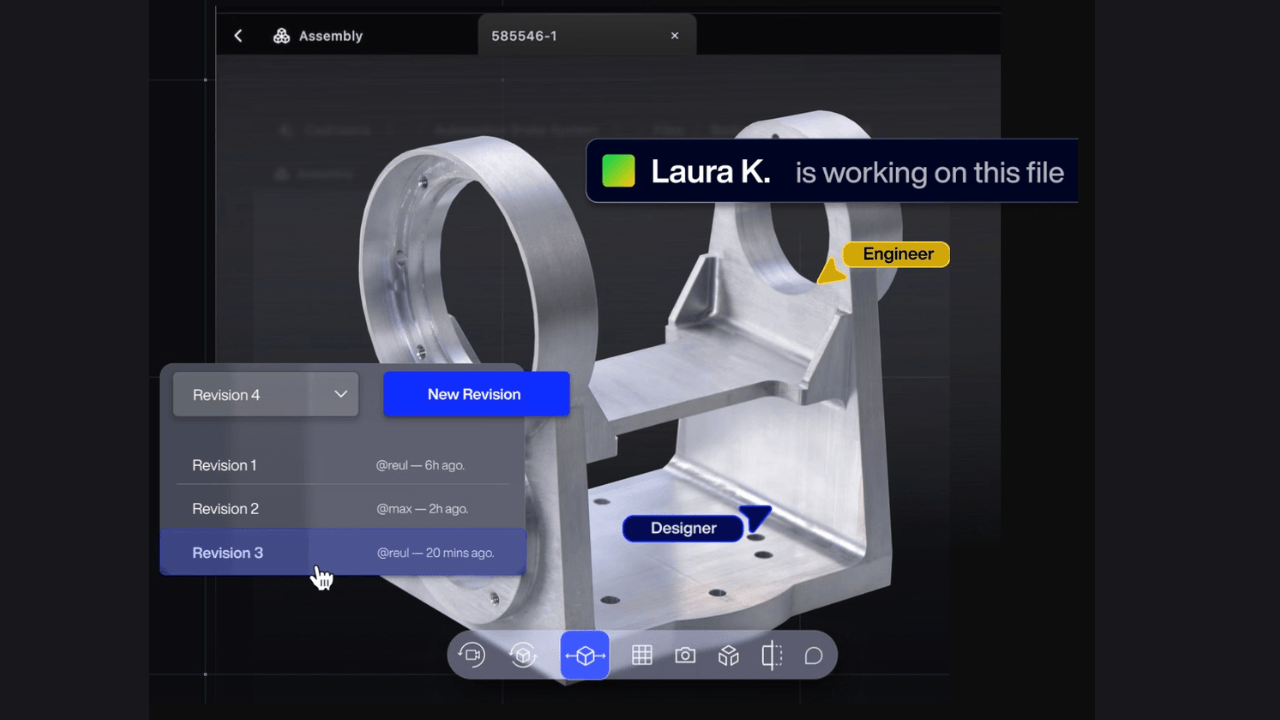
CAD ROOMS is a cloud-based product data management and collaboration platform that allows engineering teams to manage, review, and securely share CAD files across different design tools without replacing the CAD software they already use.
Rebel contends that the IAA is a bigger deal for engineering teams than most people are realising.
“If ‘made in EU’ becomes a condition of public procurement, the conversation can’t stop at the product rolling off the line. It has to start much earlier — at the tools your team uses to design it, version it, and collaborate on it.”
Right now, most engineering teams are running their entire product development process through US-hosted platforms. Every CAD file, every revision, every piece of IP lives on infrastructure outside EU jurisdiction.
That’s a problem that a procurement label on the finished product doesn’t fix.
From open-source hardware to CAD ROOMS
Rebel has over a decade of experience in cloud engineering collaboration, digital manufacturing, CAD data management, and distributed product development. Rebel is both Spanish and Dutch and grew up internationally, including in China where she saw the internationalisation of production first-hand.
Following study in politics and economics at university, she spent time helping others build startups, from idea generation to business-model development. At the same time, the maker movement was emerging.
She recalled:
“I was fascinated by the way people were starting to share hardware designs in the way software developers shared code: building on the shoulders of giants, remixing things, and learning from one another.”
From this, Wikifactory emerged in 2016, essentially a cloud collaboration and product-data platform for hardware engineering and manufacturing like GitHub, a CAD collaboration tool, and a manufacturing platform, but built specifically for people designing physical products. The community grew to around 150,000 engineers around the world, and served much of the Fab Lab and makerspace ecosystem.
However, Rebel admitted that the team realised the model was difficult to scale sustainably. The team had spent about two years trying to work out how to marry open-source and private collaboration in hardware and engineering,
“Ultimately we realised you can't really marry those two contexts. For commercial customers, the possibility that their IP could be disclosed was obviously a huge concern.”
At the same time, she was hearing more and more from professional engineers that what they really needed was the private product data management and collaboration side of what they'd built.
The team separated its fully private product into a completely different environment and founded CAD Rooms. The product is end-to-end encrypted, both in transit and at rest, and the company subsequently achieved ISO certification.
Engineering software is still stuck in the 1990s
Rebel contends that engineers are probably one of the professional groups that have been least well served by modern software. She asserts that engineers are still collaborating like it's the 1990s.
“You're talking about siloed, bureaucratic and rigid systems, and they need modern collaboration tools.”
One of the biggest issues is that industrial companies don't necessarily use a single CAD tool. They might be using PTC Creo alongside SOLIDWORKS, or SOLIDWORKS alongside CATIA, or another combination. And they’re not necessarily going to buy and implement a vendor-specific Product Data Management system for every CAD tool they use. These systems can be expensive, and implementation can take a long time. Instead, they need something simpler and interoperable that works regardless of which CAD system you're using.
CAD Rooms also wants to bring down the barriers to collaboration:
“You shouldn't necessarily need to have CAD software installed simply to participate in a design review. You should be able to measure, review and collaborate professionally around the design in a secure environment.”
Further, today’s software needs to accommodate Mechanical engineers increasingly need to work alongside electronic engineers, for example, who may be using much more modern tools such as Altium, which is already cloud-based. When legacy mechanical engineering tools don't work effectively with those systems, information starts falling through the cracks. The same applies to simulation. Incredibly powerful simulation tools are emerging, creating opportunities for new companies to enter areas such as satellites and aerospace.
Rebel asserts that Europe has amazing industrial clusters, so new players genuinely have a chance. But they're not necessarily taking full advantage of those newer tools because their legacy systems don't interoperate seamlessly with them. The wrong part gets sent to the manufacturer. Somebody overrides somebody else's work. People spend a day trying to work out which version they're supposed to be using. If you can solve those problems for newer companies, you can remove a huge amount of friction.
“Our own customer base has evolved as well. We now have enterprise customers, which previously would have been impossible for us.
They often begin with pilots because they want to understand whether they can bring those collaboration benefits into much larger organisations. Their existing systems are often decades old, and people hate using them.”
Europe can fund research — but can it fund hardware companies?
Rebel believes there's also frustration among European startups.
“They see regulation limiting things such as material choices or how products need to be designed. That's why initiatives such as EU Inc. are interesting. There is an impetus to build European companies and take advantage of the European market, but we need to make it easier in practice.”
We were seeing a huge number of hardware projects emerging through the community, but the capital wasn't following them. Rebel admits she originally thought a more community-driven growth model for hardware could work “because we'd seen it work in other sectors.”
“But one trend I expected to emerge — and didn't, at least to the extent I expected — was much greater access to capital for hardware.
Europe has an opportunity to bridge that gap. Sometimes what a hardware startup needs is €20,000 or €50,000 to get to its first working prototype."
The China problem in European hardware sovereignty
In terms of European hardware sovereignty, Rebel sees electronics as a major sticking point. When the company launched its manufacturing network, the team spoke to open-source hardware companies about diversifying their supply chains.
Products that had historically been manufactured in one location could potentially be produced by additional suppliers, opening up access to markets such as the US. But electronics repeatedly proved more difficult.
“You might be able to fabricate an enclosure in the US or Europe, but the core electronic components simply weren’t available locally, or the European pricing made the final product uncompetitive.”
Rebel says this highlights the strength of China’s manufacturing ecosystem, where component suppliers, manufacturing expertise, and entrepreneurs operate in close proximity.
“You see the depth of the Chinese ecosystem everywhere. Look at electronics platforms or even Kickstarter: Chinese companies are incredibly entrepreneurial and innovative, and we’re seeing the same thing now in robotics.”
For European startups, the challenge is particularly acute during the earliest stages of product development. Rebel has seen founders receive European manufacturing quotes that simply make their first functioning prototypes economically unviable.
“They say, ‘We simply can't do that. We need to test whether this works so that we can raise our next investment.’”
A hardware startup might need validation from its first thousand customers before investors are willing to provide further funding.
“Yet reaching those customers may require sourcing or manufacturing at least part of the product outside the EU. Once they reach larger production volumes, they may have more European options. But those early stages create a real constraint.”
Digital manufacturing requires more than uploading a file
Rebel argues that the digitalisation of manufacturing is not something that happens once. Like AI adoption, it is an ongoing process.
“Specifying something for manufacturing requires enormous practical knowledge. Every 3D printer, every material, and every manufacturing process can involve a long list of configuration choices.”
Some digital manufacturing platforms make the process appear as simple as uploading a file and receiving a finished part. But specifying something for manufacturing requires enormous practical knowledge. Every 3D printer, every material, and every manufacturing process can involve a long list of configuration choices.
While some digital manufacturing platforms make the process appear as simple as uploading a file and receiving a finished part, Rebel says the reality is considerably more complex.
“There has to be a conversation around tolerances and other manufacturing requirements.
We've had more than 15 years of Horizon programmes and, through Wikifactory, we were involved in distributed manufacturing initiatives bringing together some of the best universities across Europe.
There is a genuine grassroots ecosystem, including projects looking at how manufacturing can become more inclusive.”
She believes one way Europe can strengthen its hardware ecosystem is by giving students and young companies more opportunities to develop these skills in practice, including grants that allow startups to take prototypes through to genuinely functioning products.
Design for manufacturing, she argues, can ultimately make or break a hardware startup. But education is only part of the equation, we also need to better connect startups and universities with Europe’s small and medium-sized manufacturers.
“There are many excellent production providers in Europe. We need to make them more visible and connect them with the next generation of companies so startups can learn from their experience and reduce mistakes.”
Software can also help make those relationships more efficient.
With CAD Rooms, for example, a team can share a 3D model with a manufacturer inside an encrypted environment, allowing the manufacturer to review and discuss the design without necessarily downloading the source file. The alternative can involve exporting the design to a STEP file, breaking its connection with the original source model, and then communicating proposed changes through screenshots and lengthy annotated email threads.
“That’s where mistakes happen. Hardware is hard, and mistakes are unforgiving. It’s not software where you break something and fix it a minute later.”
Ultimately, Rebel sees improving efficiency as an important part of making European hardware manufacturing more competitive.
“If we can make European hardware companies more efficient, they have a much better chance of competing.”
“at the cusp of a hardware age.”
For Rebel, timing is everything:
“We've been involved in bids in the past where sometimes we were simply too early. That's one of the lessons from Wikifactory: you often think you're too late when actually you're ahead of where the market is.”
Now, she feels we’re “at the cusp of a hardware age.”
“We know we're able to provide an EU-hosted, end-to-end PDM solution.”
Rebel predicts that we could be entering a golden age for hardware financing.
The risk in robotics and defencetech hackerspaces has, for example, parallels with COVID, when you saw these incredible communities emerge incredibly quickly. Thousands of people were working on open-source engineering projects, medical equipment and other urgent problems. But when confinement ended, many of those communities disappeared almost immediately.
Rebel muses that perhaps the entrepreneurial layer was missing.
“If that isn't there from the beginning, it can be very difficult to turn an emergency initiative into a sustainable company. That's what makes building the underlying industrial ecosystem so important.
Once you have that fabric, it can sustain innovation over time.”
Rebel also reflects a growing sentiment. that there are diverse ways to success, especially when it comes to company growth:
“At one stage I had a team of around 30. Now we're a team of five, and we're much more effective. That's because we're focused on the core problem and the core user. We're spending our time building the product for them.”


Would you like to write the first comment?
Login to post comments