

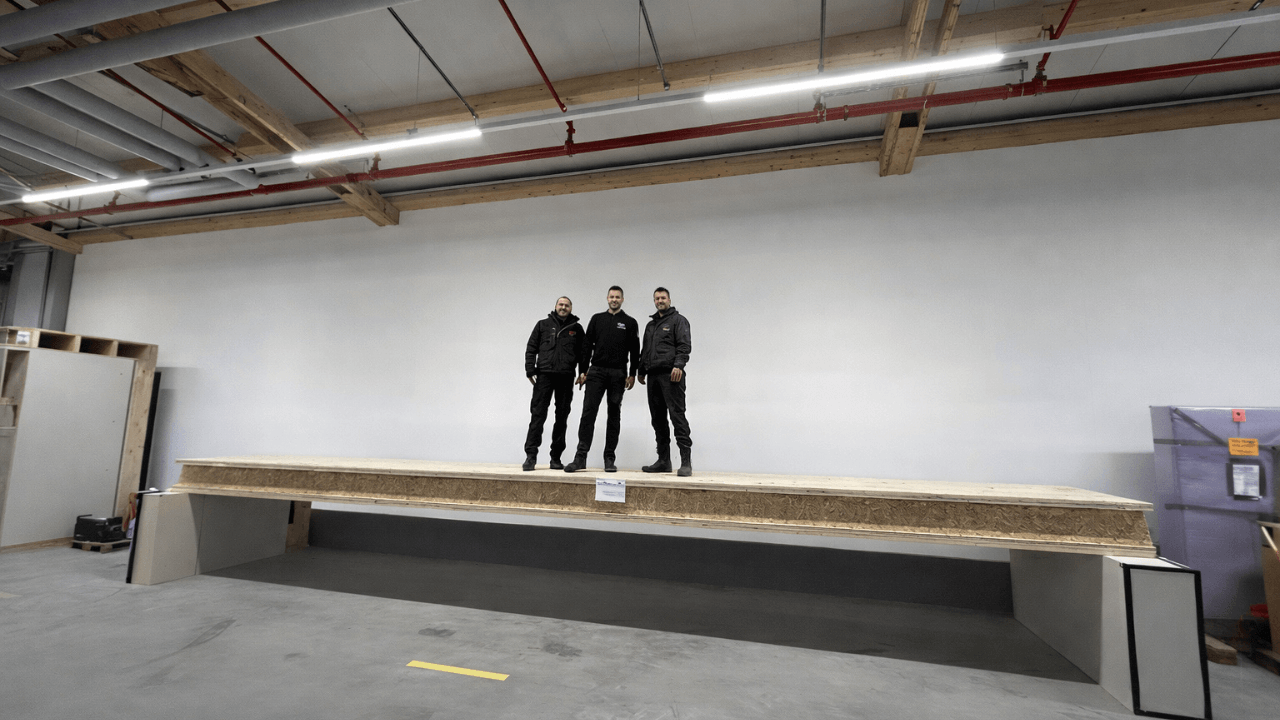
Strong by Form, a deeptech company reimagining wood as a high-performance material, has raised €5.8 million Series A round. Founded in Chile, Strong by Form is headquartered in Madrid and also operates from Santiago and Stuttgart.
A slab that lets timber compete with concrete
Concrete and steel are two of the largest sources of embodied carbon in construction, and pouring concrete on-site is one reason the industry's productivity has barely moved in decades. Timber promised a way out — it stores carbon and can be manufactured off-site — but mass timber solutions have struggled to simultaneously match the strength, span and economics required for large-scale adoption.
Strong by Form's answer is Woodflow-core, a structural slab built to compete on the two things that actually decide what gets built: strength and price, not a sustainability premium.
The opportunity is large. Concrete slabs are roughly a $120 billion global market, while Cross-Laminated Timber reaches less than $1.5 billion of it.
Rather than compete with mass-timber producers, Strong by Form partners with them, giving those manufacturers a path into a market up to 80 times larger while improving their margins by up to 50 per cent.
Building wood the way a tree grows
Strong by Form CEO Andrés Mitnik is an engineer by training who studied economics at Harvard before working as a consultant in New York and later in innovation and venture capital in his native Chile.
The idea for Strong by Form emerged from Mitnik’s friendship with two architects who shared an interest in sustainability and more efficient construction. One co-founder began exploring whether the principles behind lightweight carbon-fibre structures could be applied to natural fibres, while the other, Daniel, brought expertise in digital fabrication. They explored several natural materials before settling on wood, which is widely available and could be shaped and aligned to provide structural strength while minimising unnecessary material.
Mitnik saw the potential to turn the technology into a large-scale business:
“If we want to have an impact, we need to build a huge company. Forget about this being a cool innovation project. This needs to be a company, and we need to raise venture capital.”
That combination of materials science, digital fabrication, and commercial ambition became Strong by Form.
Woodflow is inspired by biomimicry, specifically the way trees grow. Trees add material for stiffness and align their fibres according to how forces move through the structure.
“We aren’t printing wood because we think the best 3D printer for wood is a tree.”
Instead, Strong by Form works with what it calls macro elements, preserving the structural integrity of the wood fibres rather than decomposing them. With wood flakes, the fibres are aligned and formed into structural components. With larger pieces of wood, the company controls where the material breaks when shaped.
Strong by Form's Woodflow technology uses computational design to place structural fibre only where a building actually needs it, mimicking how a tree grows extra material where it's under load. As a result, Woodflow-core is lighter than concrete and needs up to 75 per cent fewer trees than comparable mass-timber products.
Woodflow-core is designed to match the strength of steel and concrete while weighing 80 per cent less. It is intended for high-rise and industrial buildings. Strong by Form also produces Woodflow-skin, an ultra-thin and strong architectural cladding with unique wave patterns. It's sold in the US, UK and Europe and is already used in trains and interiors.
Meanwhile, Woodflow-core is currently at TRL 6 and is undergoing advanced prototyping and technological validation phases.
The two approaches serve different markets. The higher-productivity flake process is designed for construction, while larger pieces are used for mobility applications that require a higher strength-to-weight ratio.
Using more of the tree
One advantage of Strong by Form's technology is that it can work with a wide variety of wood species. The goal is to use locally sourced wood wherever possible, reducing transport emissions. Unlike conventional structural timber, Woodflow uses wood flakes rather than solid wood. Only a limited number of species, primarily pine and spruce, produce the long, straight logs required for structural timber, encouraging monocultures.
“You have forests consisting of a single species, which is a big problem in Germany right now because those forests are being killed by bark beetles,” explained Mitnik.
Conventional structural timber also uses only around 40 per cent of a tree, according to Mitnik, with the remainder typically going into lower-value applications. Strong by Form says its process can use up to 90 per cent. Mitnik explained:
“We take the tree, transform it into flakes, and then recompose those flakes. That allows us to use very low-grade wood, including wood that currently has no commercial value.”
In the long term, it could also let forest owners run more diverse plantations because it can extract value from a much broader set of species, rather than only those that are commercially viable today. Why hasn’t anyone done this before?
As always with materials innovation, I wanted to understand why no one else had pursued this approach. According to Mitnik, a professor at Rosenheim University explored a similar concept in the 1980s, but the enabling technology wasn’t ready.
“The software and robotics weren’t there. Everyone, including us, initially thought we needed robotics and completely different ways of manipulating wood to create 3D objects through additive manufacturing.
We started from the same point, but this time the robotics and software were there, so we had a shot.”
He also thinks the approach wasn’t explored to any great extent because it looked incredibly challenging to scale. “When you use robots for additive manufacturing, there are productivity ceilings you cannot beat. That’s why digital fabrication often doesn’t scale. But as the team mastered the technology and understood it better, it started simplifying it.
The team started with robotics, creating very complex shapes and extremely lightweight, high-performance components.
Fortunately, with construction, you don’t need the same efficiency you need for a race car. You just need something better than concrete.
“We think we can eventually be even cheaper. It’s about putting the right equipment together in one place. Nobody else has these pieces of equipment together because nobody else uses wood the way we do, but we aren’t using new technology. All of this technology is already available at an industrial level.”
This enables the company to compete with traditional industries such as cement.
“They’ve existed for hundreds of years, but their processes are older. Their plants aren’t necessarily as productive as they could be if you were starting from scratch, which is what we’re able to do.”
Finding where Woodflow actually works
Woodflow can be applied across architecture, construction, mobility, interior design, and maritime, but Mitnik says the key is identifying applications where it can genuinely compete on performance and price. In construction, Strong by Form isn't advocating for fully timber buildings. Instead, it wants builders to replace individual components where Woodflow offers an advantage.
“We’re telling them: get rid of a single component, replace it with this one, and it will optimise your whole building.”
The company has worked with BMW on structural components for cars, including body and interior parts. However, the automotive industry is already extremely efficient. While its technology can deliver the same strength as aluminium at a lower weight, it is not yet cheaper.
“Our manufacturing needs to continue developing before we can really become a player in that market.”
Rail, however, emerged almost by accident. Strong by Form developed a weather cabin through a Deutsche Bahn open innovation competition and was subsequently invited to showcase the project at a railway industry conference. There, Dutch railway operator NS (Nederlandse Spoorwegen) saw the technology and approached the company with another potential application.
“They said, ‘We saw what you did. Can you do something else?’ And that’s how it happened.”
Mitnik says rail is particularly well suited to the technology. Train manufacturing involves more manual labour and less standardisation than automotive, while lightweight components can reduce energy consumption. Sustainability is also a meaningful part of the sector’s value proposition.
“We might even be a little more expensive than what they currently use, but because we align with their KPIs, it works.”
Scaling without becoming a manufacturer
The company's business model is to license its tech rather than become a manufacturer.
“We’re good at creating technology and finding use cases. They know how to manufacture.”
Crucially, three forestry companies are among Strong by Form’s investors.
“These companies have allowed us to work on our first prototypes and pilots. We have access to their labs and infrastructure, and that has helped us reach the prototype level we’re at today,” shared Mitnik.
Vinci Construction is also helping provide a route to market for the technology. Mitnik says regulatory and commercial pressures are creating incentives for the sector to adopt lower-carbon materials, with France among the countries leading the transition. Strong by Form is now working with Vinci on hybrid buildings.
“Through talking to Vinci, we realised this was our way into the industry. We don’t tell construction companies, ‘Do something completely new.’ We say, ‘Change one thing, and this will have a big impact.’”
Woodflow is designed to fit into existing construction supply chains. Rather than selling directly to construction companies, Strong by Form works with manufacturers of mass timber, or CLT, which combine Woodflow with their existing products to produce the finished floor.
The structural floor has been deliberately designed to resemble a conventional mass-timber slab and work with the same screws and connections, allowing contractors to use existing skills and equipment. Strong by Form also relies on assembly partners to tailor components for individual projects, avoiding the complexity of working directly with construction sites.
“Every construction project is unique and full of uncertainty. Our assembly partners already know how to deal with that. We think we can scale much more quickly this way.”
From pilot plant to industrial scale
The round is led by boisei investments, a subsidiary of boisei labs, a US-based family office and "tech for good" venture studio, and joined by CMPC Ventures, the global forestry group that led the company's seed round, together with VX Ventures, Ternel, Savia Ventures, Teampact Ventures, Axel Carbon, FINSA, and a group of confidential family offices.
According to George Perry, President and founder of boisei labs:
"Strong by Form is exactly the kind of company we back: deep science applied to one of the largest decarbonization challenges on the planet, with a business model that wins on economics alone, not on goodwill."
Bernardita Araya, Fund Manager of CMPC Ventures, said:
"We have supported Strong by Form since its early stages because of its unique approach to engineering wood inspired by nature, opening new possibilities for wood as a high-performance, resource-efficient material.
This milestone reflects the progress the team has achieved and provides an important foundation for the next phase of industrialisation and market adoption."
The new capital will fund manufacturing capacity in Europe and take Woodflow-core through certification and market entry over the next two years, deploying with construction partners in Spain, France, Germany, and Switzerland.
Mitnik says Strong by Form’s use cases have largely emerged through conversations with industry rather than being predetermined by the company.
“We haven’t invented our use cases. They’ve come from conversations with companies. We’re always eager to see where the industry takes us. We often say no because the technology doesn’t work everywhere.”


Would you like to write the first comment?
Login to post comments