

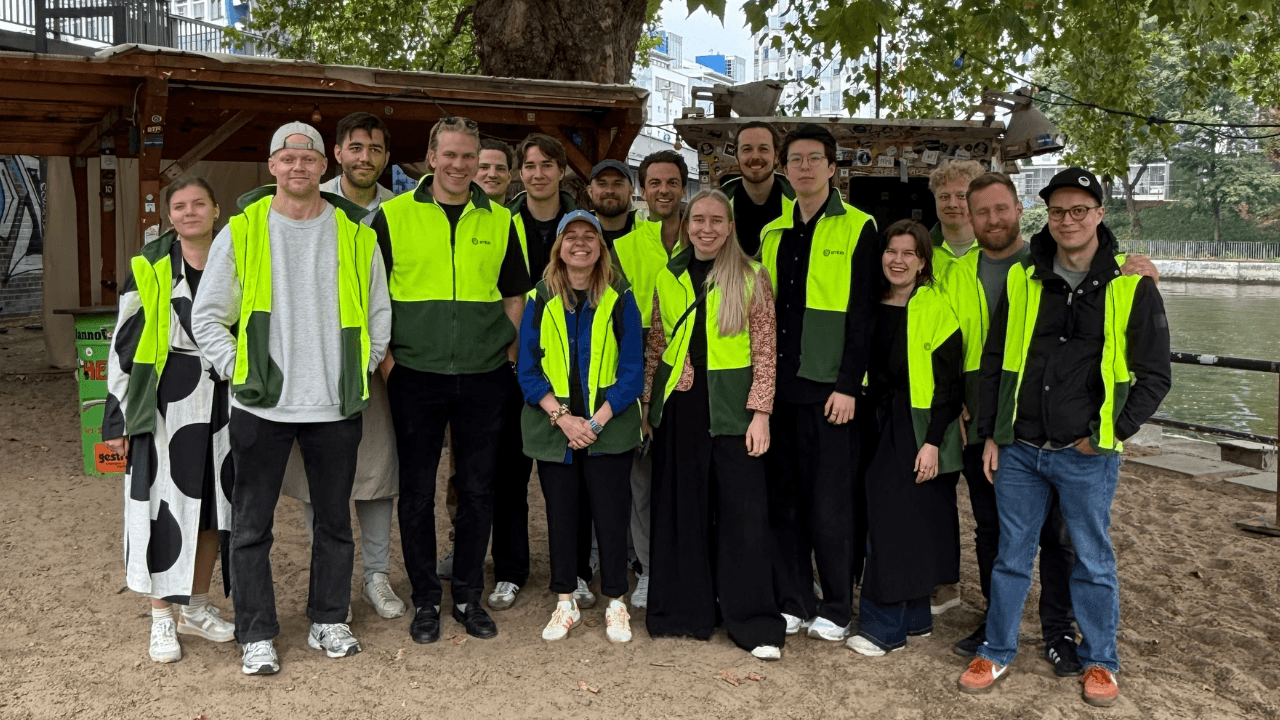
Helsinki-based startup Ambio has raised a €5.1 million seed round led by b2venture, with participation from Montis and existing investor Lifeline Ventures, to bring greater trust, reliability, and speed to recycled plastics procurement.
Founded in February 2023 by two former Slush team members, Ambio is developing an AI-powered, end-to-end procurement platform that makes recycled plastics easier to source, assess, and trade, covering the entire purchasing cycle from material discovery and sampling to long-term deliveries.
I spoke to co-founders CEO Tommi Bergström and CPO Elmo Pakkanen to learn more.
Fragmented supply and inconsistent quality hinder plastics recycling
According to Bergström, the recycled plastics market remains fundamentally broken.
"Supply is highly fragmented, quality is unpredictable, pricing is inefficient, and there isn't a reliable way for materials to be traded and moved."
In the European Union alone, roughly 50,000 companies use plastics as raw materials, compared with approximately 1,500 companies recycling them. While plastic might appear to be a straightforward commodity, there are thousands of variations, and manufacturers require specific grades for different applications.
Finding the right material among Europe's recyclers can therefore be a significant challenge. Quality presents another obstacle, particularly with post-consumer recycled plastics. Material characteristics vary depending on the waste streams recyclers receive, making it difficult to guarantee consistency between batches.
Bergström explained:
"The composition of recycled plastics is heavily dependent on the waste streams that recycling companies receive. There's always some variation in the feedstock, which can lead to quality issues, particularly when recyclers don't have complete information about what they're processing or aren't communicating clearly enough with customers."
These challenges are compounded by fragmented data and largely manual procurement processes. Information about material specifications, availability, and performance is often scattered across suppliers, making it difficult for manufacturers to compare alternatives and source recycled plastics at scale.
Yet demand for recycled materials is growing, driven by sustainability commitments, regulatory requirements, and customer expectations. Recycled plastics can also offer a price advantage over virgin materials, while sourcing them within Europe can reduce dependence on imported fossil-based feedstocks.
However, Bergström believes wider adoption depends on improving trust in the purchasing process:
"When you're buying virgin plastics, you know exactly what you're getting. When you're buying recycled, you'll know if it works when it's running in your production line.
Our goal is to predict if the material works or not before sampling even happens."
How Ambio uses AI to bring trust to recycled plastics procurement
Ambio aims to make recycled plastics procurement more predictable by combining verified materials, structured quality data, AI-powered matching, and supply chain management.
Unlike a conventional marketplace that simply connects buyers and sellers, Ambio acts as a principal in transactions, taking responsibility for sourcing, quality assurance, and delivery.
The platform brings together information about recycled materials, including their feedstock, technical specifications, historical performance, pricing, and suitability for different industrial applications.
According to Pakkanen, the more data the platform collects, the better it becomes at recommending suitable materials. For example, if a manufacturer needs recycled polyethylene for pipe production, Ambio can assess available grades and identify those most likely to meet the required specifications.
One of the industry's biggest challenges is that much of this information remains unstructured, with supplier communications taking place over emails, phone calls, and WhatsApp rather than centralised systems.
Pakkanen explains:
"Recycled plastics aren't straightforward commodities, but by building a structured data model around their properties and performance, we can make them much easier to compare and trade."
Ambio's matching engine combines conventional technical analysis with AI. Every plastic grade has measurable properties, including density, melt flow index, and impact strength. The platform compares these characteristics against manufacturers' requirements and examines how particular materials have performed historically. However, not every factor can be captured through numerical specifications.
"We look at how materials have behaved in specific applications, what customisations customers have requested, and other information that doesn't fit neatly into numerical categories."
LLMs help interpret this unstructured information and identify relationships that might otherwise be difficult to capture, enabling more informed material recommendations.
Building a proprietary dataset from scratch
When Ambio started, there was no comprehensive dataset covering Europe's recycled plastics suppliers and their available materials.
"The dataset we needed didn't exist, so we had to build it from scratch," shared Pakkanen.
Initially, the company operated almost as a sourcing service, asking manufacturers what materials they needed and contacting recycling companies to identify suitable suppliers. It quickly became apparent that publicly available information was often incomplete or outdated.
Suppliers did not always maintain accurate online inventories, and Ambio had no centralised system to retrieve reliable product information. The founders therefore began building their database through direct outreach, conversations with suppliers, and manual data collection.
While much of that work has since been automated, those early efforts established the foundation of Ambio's proprietary database of recyclers and recycled plastic grades. Each transaction now adds further information about material quality, suppliers, pricing, and outcomes, which the company uses to improve its matching and procurement processes.
Verifying quality before materials reach the production line
Verification is another important part of Ambio's offering, particularly given the variability of post-consumer recycled plastics.
Bergström says the company begins with rigorous supplier due diligence, including physical or virtual visits to recycling facilities to assess their operations and processes. Ambio also reviews technical documentation, historical quality data, and certifications, including RecyClass, which is used to verify recycling-related claims. However, documentation alone cannot guarantee that a material will perform as expected.
"Ultimately, materials need to be tested. We use the available information to recommend a suitable material, and then the customer evaluates it using a sample that we provide."
The company works with manufacturers already using recycled plastics, as well as those seeking to replace virgin materials. Some customers are looking for more reliable alternatives to existing suppliers, while others want to increase the proportion of recycled plastics in their production processes.
From manual sourcing to agentic procurement
Ambio's longer-term ambition is to automate much of the work involved in sourcing, matching, trading, and transporting recycled plastics while keeping humans in the loop. Material matching is one of the activities that can already be substantially automated. AI agents can also help read documents and emails, draft communications, extract information from multiple sources, and organise it into structured datasets.
The overall aim is to develop a system that handles much of the operational workload while leaving important commercial decisions to people.
According to Mathias Ockenfels, Partner at b2venture, Ambio's combination of proprietary data, supply chain responsibility, and agentic technology creates a competitive advantage.
"We are backing Ambio not only because of the talented team led by Tommi and Elmo but also because of the compounding competitive moat the business is built on: a proprietary dataset on recyclate quality, a principal model that builds trust with buyers and sellers, and an agentic engine that turns every transaction and quality data point into improved matchmaking.
We are convinced that Ambio will become the central marketplace for recycled plastics in Europe and beyond."
Ambio has grown significantly over the past year, refining its go-to-market strategy and securing repeat business from customers who are increasing their spending. The company currently serves customers in the Nordics and German-speaking Europe, has recently made its first hire in France, and sources recycled plastics from suppliers across Europe, including Poland, Romania, the Baltics, Germany, France, and the Benelux countries.
From Slush to startup founders
Helsinki's Slush conference has become a breeding ground for startup founders. Research released in 2025 found that 15 per cent of former Slush team members surveyed, 68 of 459, went on to found companies, more than double the proportion of 18–24-year-olds founding businesses in Finland.
Check out our earlier interview with Aino Bergius, CEO of Slush, and Mikko Mäntylä, former Slush President and now co-founder and CEO of Realm, to learn more,
Both Bergström and Pakkanen worked at Slush before founding Ambio, and that experience helped shape their entrepreneurial ambitions.
According to Bergström, one of the biggest lessons from working on Slush's core team was that “you're given a tremendous amount of responsibility at a young age, and people trust you to deliver. That builds confidence and creates a mindset that you can genuinely shape the world around you."
He credits the experience with giving them access to a network of investors, founders, and potential partners, even though it did not provide direct connections to the recycled plastics industry.
For Pakkanen, being surrounded by people building international companies helped him see entrepreneurship as an opportunity to create something global rather than simply establish a small business. Equally influential was the encouragement to start building rather than wait until he had accumulated years of experience.
"If you told someone you wanted to found a company, the response was often, 'Why don't you just go and do it?'"
That willingness to take the leap, experiment, and learn along the way ultimately helped bring Ambio to life.


Would you like to write the first comment?
Login to post comments