

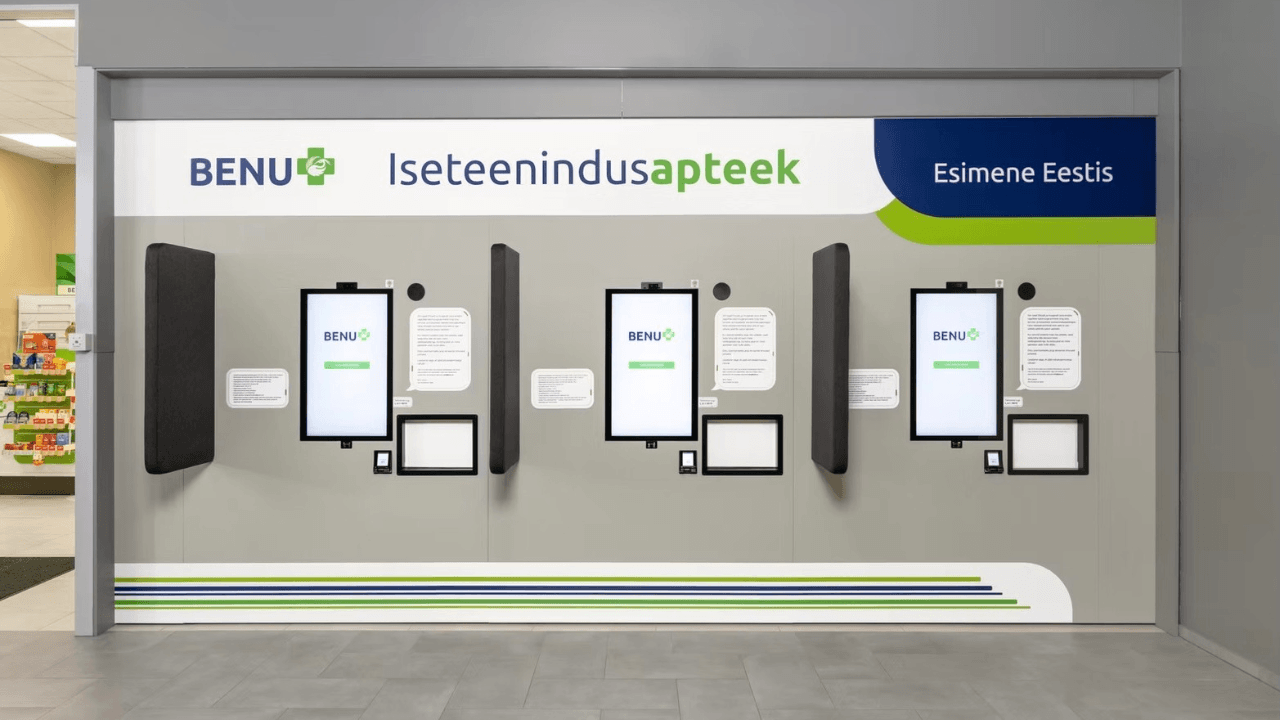
The Estonian government has today approved draft legislation paving the way for 24/7 robotic pharmacies, allowing patients to obtain prescription and over-the-counter medicines without a pharmacist physically present on site. The proposed amendments to the Medicinal Products Act would enable automated self-service pharmacies equipped with digital identity verification, remote video consultations with licensed pharmacists and robotic medicine dispensing.
The bill must still pass through parliament, with implementation targeted for 1 March 2027.
If enacted, Estonia could become the first European country to introduce remote prescription medicine dispensing through automated pharmacies, going beyond existing collection lockers and systems limited to non-prescription products.
At the centre of the initiative is Estonian technology company Grab2Go, whose co-founders Mart Viilipus and Reio Orasmäe encountered legislation requiring pharmacists to be physically present when dispensing medication. Rather than abandoning the project, they approached Accelerate Estonia, a government-backed innovation programme run by the Ministry of Economic Affairs and Communications.
Working with the Estonian Medicines Board and Ministry of Social Affairs, the programme helped identify the regulatory changes needed to bring the technology to market while maintaining patient safety.
I spoke to Reio Orasmäe, co-founder and CSO of Grab2Go, and Olari Püvi, Head of Accelerate Estonia, to learn more.
A pharmacy at 2 am
Automated pharmacies could improve access to medication outside conventional opening hours. As Orasmäe notes:
“Whether you're a parent with a sick child, an elderly person or someone who suddenly needs medicine, accessing a pharmacy late at night, early in the morning or on a Sunday can be difficult.
Online pharmacies are becoming more popular, but delivery may take a day or two. That doesn't solve the problem when someone needs medication immediately.”
As for how it works, Orasmäe likens the customer experience to self-service ordering at McDonald's. Customers select their medication using a touchscreen before connecting with a licensed pharmacist via video consultation. The pharmacist reviews the request and authorises dispensing.
“During our six-month pilot in Estonia, a mandatory video consultation with a pharmacist was part of the process. The pharmacist could ask questions about the intended use of the medication and verify that it was appropriate for the customer,” shared Orasmäe.
Estonia has a highly developed digital identity infrastructure, allowing identification through an ID card or other digital solutions.
The robotic system handles product storage and dispensing within a secure steel enclosure accessible only to authorised personnel. No robots malfunctioned during the pilot, but Orasmäe says helping customers become comfortable with digital identity verification proved more challenging.
“In many ways, the robotics is the easiest part. Some people are very familiar with digital services, while others need more assistance.
We even had an 82-year-old woman using the system. Having someone available to help customers during the first few months when introducing a new service can make a significant difference.”
The regulatory catch-22: How do you test something that's illegal?
The Grab2Go project exposed a broader problem facing startups developing technologies that existing legislation does not accommodate. Regulators often require real-world evidence before changing the law, but companies cannot legally collect that evidence without permission to test their products.
“The Ministry of Social Affairs needed data before it could consider changing the law. But we couldn't collect that data because we weren't allowed to test the technology. It's a circular problem,” Püvi explained.
The experience prompted Accelerate Estonia to develop an experimentation framework allowing companies to test innovative products and services under controlled real-world conditions, even where existing regulations would otherwise prohibit them.
Rather than introducing permanent legislative changes before knowing whether a technology works, regulators could authorise limited trials and use the findings to assess safety, practicality and economic value.
“We regularly encounter entrepreneurs who are frustrated because regulations prevent them from testing new ideas. Some projects succeed, and others fail, but without experimentation, potentially valuable innovations can remain stuck for years.
If we'd had this framework when Grab2Go first approached us, robotic pharmacies might already have been on the market.”
Püvi believes the framework could benefit other startups facing similar regulatory barriers, extending its impact well beyond automated pharmacies.
Can robotic pharmacies solve Estonia's pharmacist shortage?
Beyond convenience, automated pharmacies could help address workforce shortages and improve access to medication in underserved communities.
“Estonia has rural communities and islands where access to pharmacies can be difficult. Automated pharmacies could improve access to medicines for people living in those areas,” explained Püvi.
Accelerate Estonia and PwC conducted an impact analysis examining the economic and societal implications of introducing self-service pharmacies. The study highlighted an ageing workforce, with 53 per cent of pharmacists and 43 per cent of pharmaceutical technicians over 50, raising concerns about staffing as more professionals approach retirement.
Automation could let pharmacists serve customers remotely across multiple locations, improving staff allocation. Püvi also sees potential to reduce pressure on emergency healthcare services.
“People sometimes seek emergency medical assistance for relatively minor problems because they cannot access medication or pharmacy services when they need them.
If someone can obtain appropriate medication from a pharmacy operating 24 hours a day, seven days a week, that could help reduce some of that pressure.”
The business case for automated pharmacies
For pharmacy operators, Grab2Go is targeting a return on investment of approximately two to three years.
“One of the biggest factors is labour costs, which continue to increase. As those costs rise, the potential payback period for automation becomes shorter. At the same time, the cost of robotics and associated components has been declining as the technology becomes more widely adopted,” Orasmäe explained.
Grab2Go intends to operate primarily as a technology provider, supplying hardware and software to pharmacy operators, with commercial arrangements tailored to individual requirements.
The company also sees international opportunities. According to Püvi, countries including Canada, Sweden, Norway and Austria have shown interest in Estonia's approach
The proposed legislation is intended to be technology-neutral, allowing other companies to develop competing automated pharmacy systems.
“We work with pioneering companies to identify regulatory barriers and create opportunities for entirely new markets to emerge. Grab2Go may be the first, but we hope other companies will follow,” Püvi said.
However, developing a product for a market that does not legally exist presents significant investment challenges.
“We sometimes joke at Accelerate Estonia that you have to be a little crazy to start a business whose product is initially illegal under existing regulations.”
Orasmäe points out that while considerable expertise already exists in warehouse automation, robotic logistics and pharmaceutical storage, customer-facing automated pharmacies require different capabilities.
“The processes, customer interactions and even the robotics themselves have different requirements.
We've invested in developing our technology to the point where we have a third version ready, but until the regulatory framework changes, customers cannot actually operate it commercially. That's a significant barrier to investment.
Once the market becomes legally accessible, other companies will have a reason to start developing competing solutions.”
Changing the law without compromising patient safety
For regulators, the central question was whether automated pharmacies could deliver the same standard of care as conventional pharmacies.
According to Püvi, the impact analysis examined approximately 30 to 40 issues, including patient safety, professional responsibilities and whether the technology addressed a genuine need.
“One important finding was that automation could actually improve the quality of the pharmacist's interaction with customers. Pharmacists do much more than hand over medication.
They're responsible for inventory, ordering products, managing the pharmacy and, in some cases, preparing or compounding medications for individual patients.”
Automating dispensing could let pharmacists focus on consultations rather than managing operational tasks. Crucially, the pharmacist retains final authority over dispensing, including for common over-the-counter medicines.
“Demonstrating that the system was safe, beneficial and could improve existing services took considerable time. In a democratic country, regulatory change requires consultation and evidence.
You need to demonstrate that the proposed changes genuinely improve the system.”
Following parliamentary approval, Estonia's Ministry of Social Affairs will need approximately three to four months to prepare the necessary digital and administrative systems and inform pharmacy operators about the new framework. Grab2Go is targeting deployment in March 2027.
According to Püvi, there was discussion about allowing the changes to take effect earlier, but that would have placed unnecessary pressure on regulators and pharmacy operators.
“There was discussion about allowing the changes to take effect as early as January, but that would have created unnecessary pressure for everyone involved.
We've been working on this for approximately two and a half years, so a few additional months to ensure everything is properly implemented makes sense. It gives regulators, pharmacy operators and Grab2Go time to prepare.”
Grab2Go's technology could potentially be applied to other regulated products requiring secure storage, identity verification and professional authorisation, such as medical cannabis, subject to applicable regulations.
Orasmäe believes automated pharmacies also improve inventory management through AI-based forecasting, stock monitoring and automatic replenishment.
“Customers shouldn't routinely have to visit a pharmacy only to discover that a common medication is unavailable and needs to be ordered.
For people managing chronic conditions, such as asthma or allergies, reliable access to medication is particularly important. The goal is not simply to automate dispensing. It's to make the entire process of accessing medication more convenient, reliable and efficient.”
For Accelerate Estonia, the broader lesson is that governments need mechanisms to evaluate emerging technologies without allowing existing regulations to prevent experimentation altogether. Püvi asserts:
“We need ways to test new solutions responsibly, gather evidence and determine whether they can deliver genuine benefits.
Grab2Go is an important example of what becomes possible when entrepreneurs and the government work together to address those barriers.”


Would you like to write the first comment?
Login to post comments