
Surgical tech company Alesi Surgical has raised £7 million in a funding round led by IW Capital and supported by existing shareholders, IP Group and Mercia Ventures to tackle the problem of surgical smoke in operating theatres .
Surgical smoke is produced in around 90 of procedures, of which there are an estimated 266 million each year. The smoke impairs surgeons’ visibility and exposes healthcare staff and patients to harmful aerosols and particulates. Although 95 per cent of surgical smoke is water, the remaining 5 per cent can contain viable viruses, bacteria and chemicals. This presents both a short-term infection risk and long-term toxicity hazard for operating theatre staff.
Historically, adoption of smoke management solutions has been limited by cumbersome extraction systems that interrupt surgical workflow. But growing regulatory momentum – led by the US, where 20 states have now passed regulations- is driving a shift towards smoke-free operating theatres becoming the standard of care.
Alesi’s proprietary Ultravision platform technology provides an innovative alternative to existing products. It uses electrostatic precipitation to actively remove smoke as it is generated rather than relying on suction and mechanical filtration.
The first-generation Ultravision System has already been used in over 50,000 “keyhole” laparoscopic and robotic procedures in Europe, the US and Japan, and independent industry studies have shown that in laparoscopic surgery, smoke is removed from the atmosphere up to 225-times faster than competing technologies. There are also a multitude of benefits for patients.
The technology reduces strain on the body by enabling surgeons to operate at lower abdominal pressure during laparoscopic and robotic procedures, reducing CO₂ usage by up to 82 per cent while maintaining a clear surgical field. This approach is associated with reduced surgical time, improved patient outcomes and recovery, and a lower cost per procedure than other available advanced technologies.
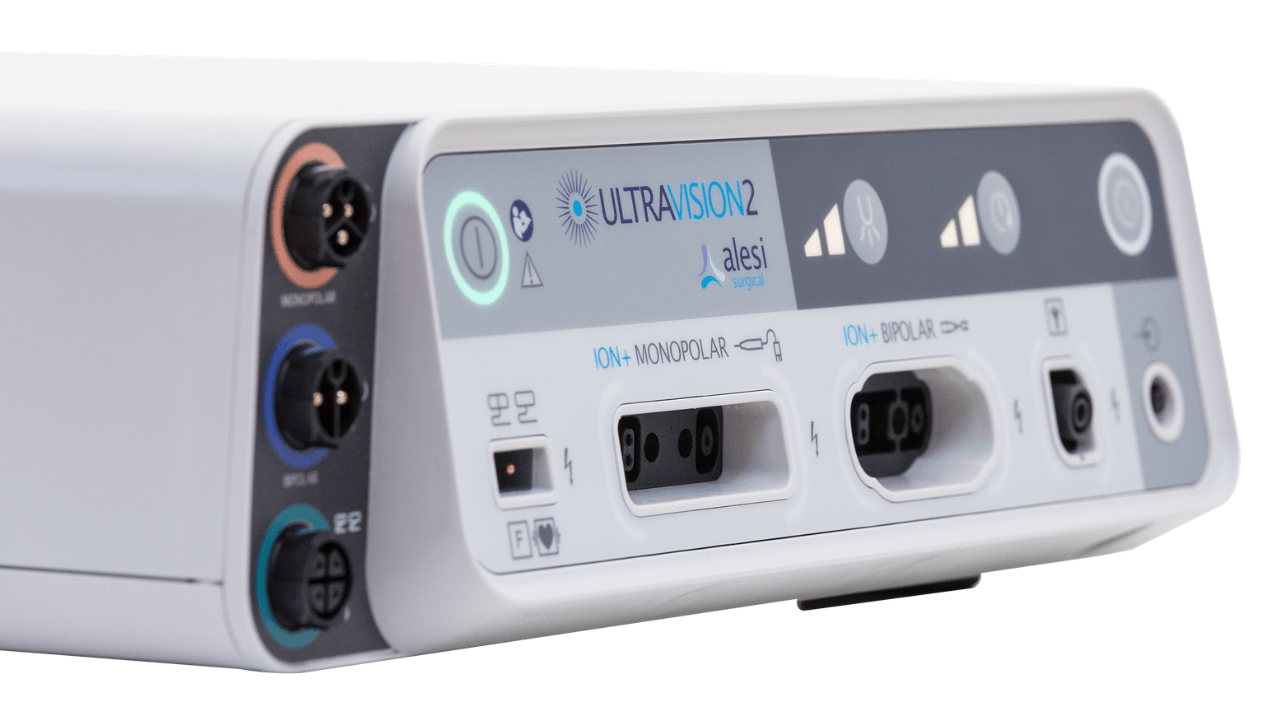
In addition to keyhole procedures, its recently regulatory-cleared next-generation Ultravision2 System can also be used in open surgery procedures where current solutions have proven unpopular, described by surgeons as inefficient, bulky, awkward, cumbersome, and noisy.
The Ultravision2 System also offers users the ability to use Alesi’s own surgical tools, which combine advanced smoke management with tissue dissection functionality.
The funding will support international commercial expansion and further development of Alesi’s Ultravision2 platform as regulations around smoke control tighten.
According to Dr Dominic Griffiths, Founder and CEO of Alesi Surgical, electrosurgical tools have transformed modern surgery, but also generate surgical smoke that affects the quality and efficiency of surgery and poses risks to operating theatre staff:
“For years, available solutions have required trade-offs between effectiveness and workflow disruption, slowing adoption across the industry.
As awareness grows that smoke management is integral to surgical safety and efficiency, solutions that tackle smoke at its source, such as Ultravision2 which is FDA-approved and CE-marked, are becoming increasingly important for supporting the next generation of minimally invasive and robotic procedures.”
Isobel Egemole, Investment Director at IW Capital, says:
“Alesi Surgical offers a fundamentally different approach to smoke management that addresses the problem at its source. As the industry moves toward smoke-free operating theatres becoming the norm, Ultravision2 is well positioned to play a key role.”


Would you like to write the first comment?
Login to post comments