

For Vexlum CEO and CTO Jussi-Pekka Penttinen, in Finland, there’s a simple way to tell if a company has moved from startup to scale-up: whether it has a sauna in the factory.
“We do. So we consider ourselves a real company now.”
When people think about semiconductors, they usually think about silicon chips. But Vexlum specialises in III-V semiconductors, which are essential for lasers, solar cells, and detectors.
The scaling up of technologies such as quantum computing and atomic clocks is currently constrained by the limited availability of compact, cost-effective, high-power laser sources at precise wavelengths.
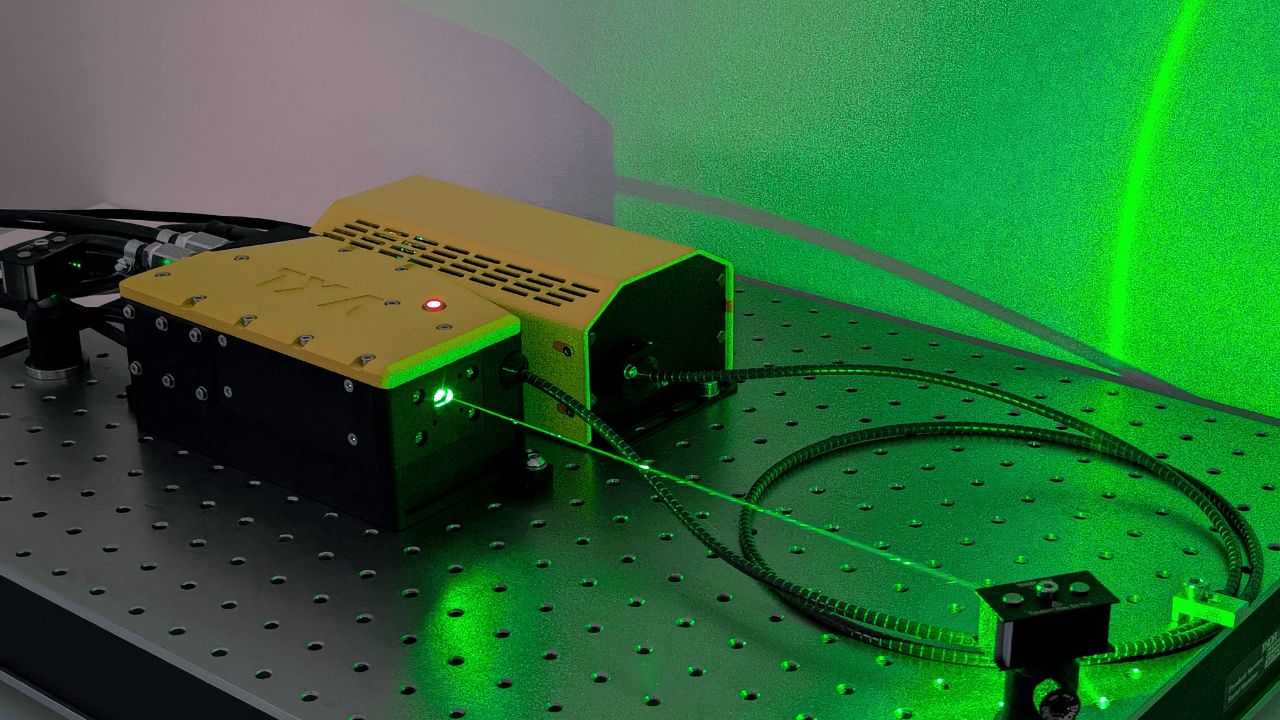
Vexlum’s proprietary lasers address this bottleneck, enabling industrial deployment of these systems. Vexlum is the outcome of more than 20 years of laser and semiconductor research.
The core technology — which the company calls VECSEL — started in 2005 at the Optoelectronics Research Centre (ORC) in Tampere.
Initially, the team was developing a range of applications, from yellow lasers for sodium guide stars in space to dermatology, where specific wavelengths can target blood vessels with high precision. Penttinen joined the research group in 2010, and a key turning point came in 2012, when researchers from the National Institute of Standards and Technology (NIST) in Boulder, Colorado, approached the company.
Penttinen explained:
“They had seen our publications and were struggling with lasers for quantum applications, particularly ion trapping. At the time, we were developing high-power red lasers for projection, but we began tailoring them for quantum use.
Together, we realised these lasers were an excellent fit for quantum systems: high power, visible wavelengths, excellent beam quality, and very low noise.
That led to the spinout of Vexlum in 2017, where I became one of the co-founders.”
Addressing a bottleneck in the quantum age
Vexlum’s semiconductor-based Vertical-External-Cavity Surface-Emitting Laser (VECSEL) technology addresses a critical bottleneck in high-tech industries: the lack of compact, cost-effective, high-power laser sources at precise wavelengths.
Applications such as atomic clocks and quantum computers, as well as next-generation semiconductor metrology and free-space optical communication, all rely heavily on lasers.
Today, Vexum produces around 200 lasers annually. A critical step in the process — semiconductor fabrication — has previously relied on equipment rented from Tampere University, but now the company is building its own fabrication facility, a move essential to support its next phase of scaling.
With this the company is moving beyond boutique production to industrial-scale capability to meet the demand from the quantum, semiconductor, and space sectors.
“We’ve already received our epitaxy reactor, and our cleanroom should be completed within a few months. The goal is to have the full fab operational within this year,” shared Penttinen.
How do you create laser?
Producing a laser is a multi-stage, highly controlled process that begins with the growth of semiconductor layers atom by atom on a substrate. Using molecular beam epitaxy, Vexlum “grows” its wafers in a reactor— effectively 3D printing at the atomic scale. These III–V semiconductor materials, such as gallium arsenide, indium phosphide, and gallium antimonide, are deposited at a rate of around one micron per hour, roughly the speed at which a beard grows.
While growing a single structure takes about a day, developing it can take weeks or even years, depending on its complexity.
Once the wafer is ready, it is processed into chips in a specialised cleanroom over a few weeks, followed by additional weeks to assemble the final laser system.
“In total, we can produce a new wavelength in about a month. That flexibility is a key advantage for us,” said Penttinen.
The finished, quality-controlled chips are then integrated into laser systems to generate light at specific wavelengths.
By owning and operating this vertically integrated process — from chip fabrication to final system assembly — Vexlum can maintain tight control over the entire value chain and respond more precisely to customer requirements.
From niche beginnings to multi-wavelength demand in quantum systems
I was curious about the strongest commercial demand for Vexlum’s lasers, given the current hype around quantum computing.
Penttinen explained that interestingly, when they spun out Vexlum, there was no hype at all: “People even told us the market was too niche."
But what started as a “too niche” research project is now becoming foundational to some of the most advanced technologies in development.
Today, demand is growing, particularly in areas such as ion trapping and neutral-atom systems. What’s important is that these systems require multiple lasers at different wavelengths.
"For example, a single quantum setup might need six different wavelengths. That’s where our technology stands out. We can deliver multiple wavelengths with high power and low noise, which is exactly what these applications require,” shared Penttinen.
Targeting legacy laser markets from semiconductors to space
Vexlum’s customers today are research institutions or commercial players, although even commercial quantum companies are still largely in an R&D phase.
“They have ambitious roadmaps, but the reality is that most systems are still being developed rather than deployed at scale, " shared Penttinen.
However, the company is looking beyond quantum to areas like semiconductor manufacturing — including developing capabilities in UV wavelengths — and metrology, where older laser technologies are still widely used.
According to Penttinen, Vexlum, lasers offer better performance, including lower noise and better beam quality, to traditional offerings, and they’re also much more energy-efficient.
“In some cases, existing systems consume as much electricity as a sauna, which is a useful reference point in Finland. So there’s a clear incentive to upgrade.”
The company is also working with the European Space Agency on laser systems for space applications, where it can replace more complex and expensive legacy solutions.
Nordic photonics gains ground with Vexlum’s €10M raise
In February, the company raised €10 million, to date the largest Seed round to date for a photonics company from the Nordics.
It included €6 million in equity investment led by Kvanted, with participation from Finnish state-owned Tesi (Finnish Industry Investment Ltd) and the EIC Fund, alongside a €2.4 million grant from the EIC Accelerator, and a €1.6 million loan from Nordea.
Sweden is home to over 200 photonics companies, with over 80 in Finland, underscoring the region’s quiet but significant depth in optical and semiconductor technologies.
The Nordics, in particular, have built a strong foundation in photonics through decades of academic research, specialised institutes, and close collaboration between universities and industry.
According to Penttinen, Tampere — and Europe more broadly — has strong expertise in this area.
“There’s a real concentration of knowledge and talent here, which is why we’re scaling our manufacturing locally.”
And, Vexlum’s bet on precision lasers is well-timed as it turns its technical edge into scalable production.
Lead image: Vexlum.


Would you like to write the first comment?
Login to post comments